
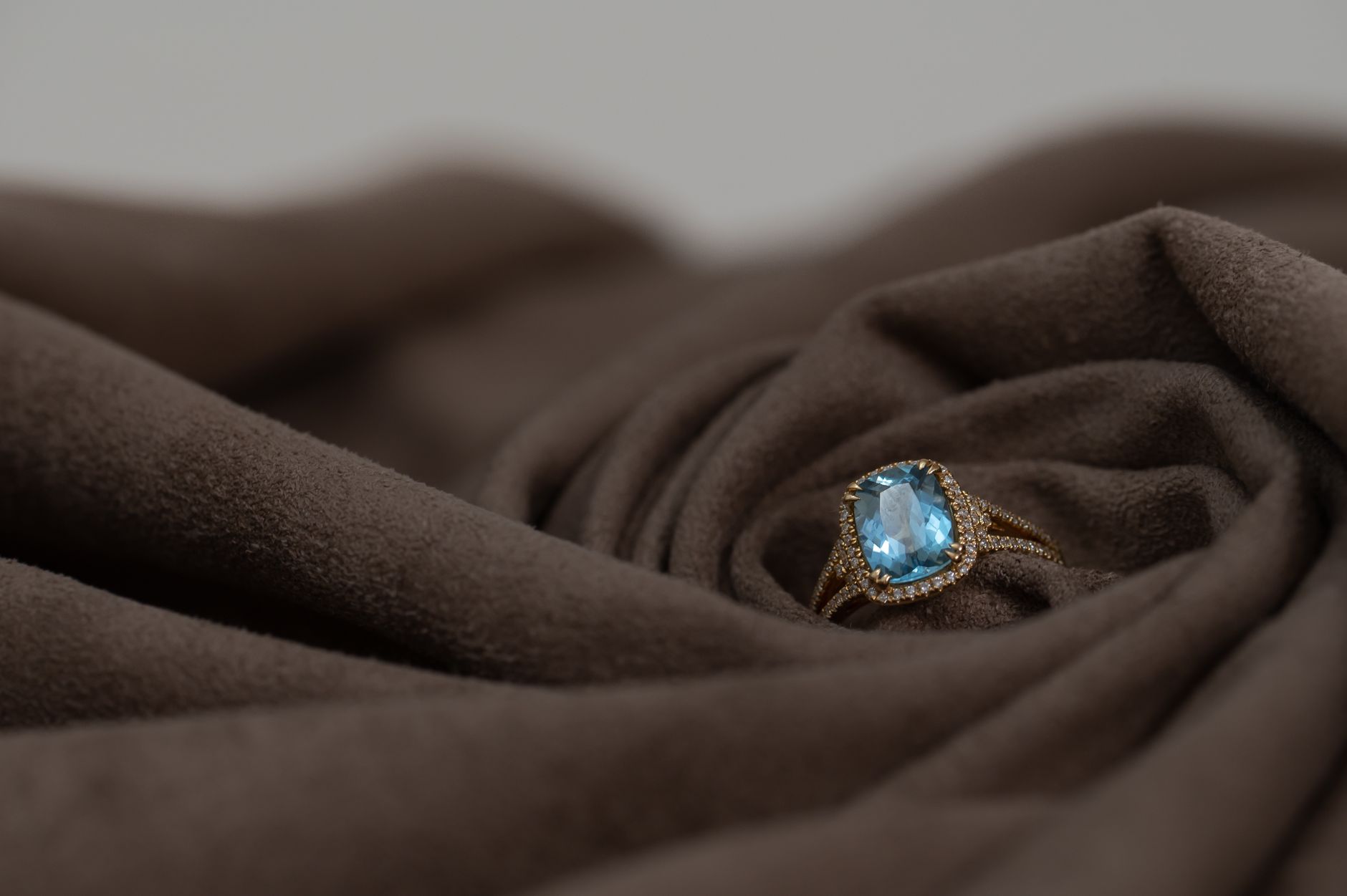
Topaz is a fine stone prized since antiquity, known to the general public for its blue shade but naturally found in a very different palette, dominated by the golden and orange tones of imperial topaz. Its high hardness makes it a solid choice for everyday jewellery, whether in a ring, a necklace or earrings. This guide explains what topaz really is, where its colours come from, its origin and history, its traditional virtues, and how to choose and care for a piece of jewellery set with it.
What is topaz?
Topaz is an aluminium fluorosilicate, a mineral that forms in certain volcanic rocks and pegmatites. On the Mohs scale, which measures mineral hardness, it rates 8, just behind corundum (sapphire and ruby) and diamond, making it a solid stone well suited to daily wear.
In its pure state, topaz is colourless. Traces of chemical elements, or defects in its crystal structure, give it colour during geological formation or through treatment. Unlike many fine stones, topaz has a perfect cleavage in one direction: a plane along which it can split if it receives a sharp blow, worth keeping in mind despite its good hardness.
The colours of topaz: natural and treated
The world of topaz splits into two broad colour families, whose origin, natural or treated, greatly affects the stone’s rarity and price.
| Colour | Origin |
|---|---|
| Blue (sky blue, Swiss blue, London blue) | Almost always treated (irradiation then heating) from a colourless stone |
| Imperial (golden, orange, pinkish orange) | Natural, untreated, mostly Brazilian for gem quality |
| White (colourless) | Natural, sometimes used as a more affordable alternative to diamond |
| Mystic (multicoloured, rainbow effect) | Obtained through a surface coating process |
| Cherry | Intense red colour, rare |
Blue topaz, the most common in jewellery
Natural blue topaz is rare. Nearly all blue topaz sold in jewellery comes from a colourless stone treated by irradiation and then heating, a stable process widely used on the market. Three shades stand out: sky blue, a very pale blue and the only one that also occurs naturally; Swiss blue, a deeper blue; and London blue, the darkest of the three.
Imperial topaz, the most sought-after natural colour
Imperial topaz owes its name to the Russian tsars, who once kept the finest stones for themselves. Today, the term refers to a natural, untreated topaz, in warm tones ranging from golden to pinkish orange, the latter shade being the most valued. It remains one of the least known natural fine stones to the general public, relative to how rare it really is.
Origin and history of topaz
The main deposits of imperial topaz are found in Brazil, in the Ouro Preto region, in the state of Minas Gerais. Other topaz deposits, mostly of colourless quality intended for treatment, exist in Pakistan, Russia, Nigeria and Sri Lanka.
The origin of the name remains uncertain: some trace it to the Sanskrit word tapas, meaning fire, others to the ancient Greek island of Topazios, now identified with Zabargad, in the Red Sea. Topaz has been known since antiquity, mentioned by Pliny the Elder, and prized by Egyptian, Greek and Roman civilisations, which used it to make amulets. One of the most famous historical topazes, the Braganza, a stone of about 1,689 carats found in Brazil in 1640, is today mounted on the crown of Portugal.
The virtues traditionally attributed to topaz
In popular beliefs and crystal healing, topaz is associated with virtues that vary according to its colour: blue topaz is said to be linked to communication and calm, white topaz to concentration, and imperial topaz to self-confidence. These virtues belong to symbolic and traditional beliefs, passed down since antiquity, without established scientific basis, and are in no way a substitute for medical advice or the support of a health professional.
Topaz is also the birthstone traditionally associated with the month of November in Western calendars, making it a frequent gift idea for a birthday falling that month, much as a sapphire is for September.
Topaz in jewellery: rings, necklaces, earrings
Topaz suits every type of jewellery, from rings to pendants and earrings. In a ring, it is often used as the centre stone, whether in a classic setting or in a thin, adjustable or zirconia ring, where it can quite easily replace the main stone. Before ordering a ring set with a topaz, it remains essential to know the exact size: the guide on finding your ring size covers the method, particularly useful for an online purchase.
Blue topaz pairs just as well with silver, which enhances its cool contrast, as with gold, which warms up the overall look. Set alone or alongside other stones, it remains a more affordable alternative to other fine blue stones such as sapphire.
How to choose and care for a piece of jewellery set with topaz
The price of a topaz depends above all on its origin: a treated blue topaz remains a modest budget, while a natural imperial topaz, rarer, comes closer to the price of other sought-after fine stones. Colour, intensity, carat weight and the quality of the setting complete these criteria.
The price of a topaz
Between a treated blue topaz, affordable from a few tens of euros for a small stone, and a fine natural imperial topaz, the price gap can be significant: it mainly reflects the rarity of the natural colour compared with the abundance of a treated stone.
Everyday care
With a hardness of 8 on the Mohs scale, topaz withstands daily wear well, but its natural cleavage makes it sensitive to a sharp blow, which can split it. It is recommended to avoid prolonged exposure to strong light or heat, which can, for some treated stones, fade their colour over time. Cleaning with lukewarm soapy water and a soft cloth is enough in most cases, without repeated ultrasonic baths.
For a gift idea matching a stone to a specific occasion, the guide on what jewellery to give for a birthday covers other useful criteria according to budget and recipient.
Frequently asked questions
What is the natural colour of topaz?
In its natural state, topaz is most often colourless or pale. Blue, by far the most common in jewellery, almost always comes from irradiating and then heating a colourless stone. Imperial topaz, in golden, orange or pinkish-orange tones, remains one of the few natural colours without any treatment.
How can an authentic topaz be recognised?
Commercial blue topaz and imperial topaz are the same mineral, but their origin differs: the former is almost always treated, while the latter owes its colour to nature alone. A gemmology certificate stating whether the stone has been treated remains the only reliable way to confirm a stone’s origin before a significant purchase.
What is the price of a topaz?
The price of a topaz varies greatly depending on colour and treatment: a treated blue topaz remains affordable, while a natural imperial topaz, rarer, reaches prices close to other sought-after fine stones. Size, carat weight and origin also affect the final budget of a piece of jewellery.
What does topaz symbolise?
Topaz is traditionally associated with strength, clarity of mind and self-confidence. It is the birthstone for the month of November in Western calendars, making it a frequent gift choice for a birthday falling that month.
What virtues are traditionally attributed to topaz?
In popular beliefs and crystal healing, topaz is associated with clarity of mind, self-confidence and calm, virtues that vary according to the stone’s colour in these traditions. They belong to symbolic beliefs passed down since antiquity, without established scientific basis, and are not a substitute for any medical or professional advice.