
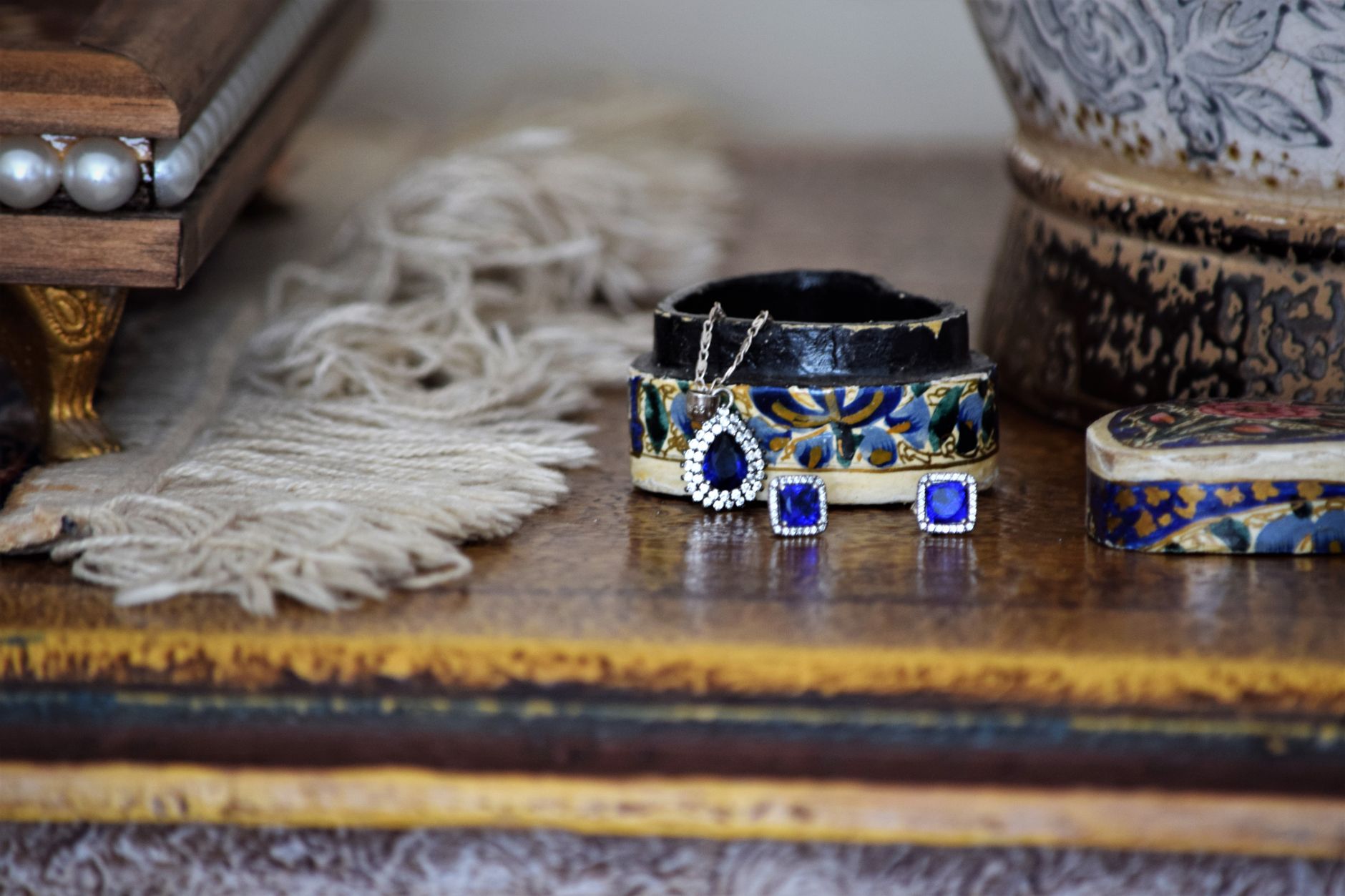
Lapis lazuli is a deep blue rock used in jewellery and ornamentation for more than seven thousand years, making it one of the earliest ornamental stones worked by humans. Recognisable by its golden flecks and fine white veining, it carries a symbolism of wisdom and truth inherited from ancient civilisations. This guide explains what lapis lazuli really is, where its colour comes from, its geological origin, its history, its traditional virtues, and how to choose and care for a piece of jewellery set with it.
What is lapis lazuli?
Unlike most fine stones, lapis lazuli is not a single mineral but a metamorphic rock, an aggregate of several minerals. It is made up mainly of lazurite, which gives it its blue colour, combined with white calcite and golden flecks of pyrite, which create its characteristic sparkling look.
On the Mohs scale, which measures mineral hardness, lapis lazuli rates between 5 and 5.5, a moderate level that makes it a softer stone than sapphire or quartz and calls for some care in everyday wear.
This composite nature also explains why no two pieces of lapis lazuli ever look quite the same: the proportion of lazurite, calcite and pyrite varies from one block to another, even within the same deposit, making each piece of jewellery slightly unique.
Where does lapis lazuli’s blue colour come from
Lapis lazuli’s colour comes from lazurite, a mineral of the sodalite family whose crystal structure contains sulphur, responsible for its intense blue shade. The finest stones show a deep, even blue dotted with fine, evenly spread golden pyrite flecks, without the broad white calcite veins that dilute the colour and are generally seen as a flaw.
Lapis lazuli is sometimes mistaken for sodalite, a more common and less expensive blue stone, which differs from it in a duller shade and the absence of golden pyrite flecks.
Origin and deposits of lapis lazuli
The world’s main lapis lazuli deposit lies in the Badakhshan region of Afghanistan, mined continuously for more than 6,000 years and still regarded as the source of the most sought-after material. Other deposits exist in Chile, where the stone often shows greenish tints linked to diopside, in Russia near Lake Baikal, as well as in Pakistan and the United States, though these generally yield a paler stone or one more heavily marbled with calcite than the Afghan material.
A stone that has travelled since antiquity
Long before the rise of maritime trade, Afghan lapis lazuli already travelled several thousand kilometres along trade routes linking Central Asia to Egypt and Mesopotamia, making it one of the first gemstones traded on a large scale in human history.
The history and meaning of lapis lazuli
The name lapis lazuli comes from the Latin lapis, meaning stone, and the Persian lazaward, which refers to the blue of the sky. The stone adorned the jewellery and funerary objects of ancient Egypt, including Tutankhamun’s mask, and was ground to make ultramarine, a highly prized blue pigment used in painting until the Renaissance, before the invention of synthetic substitutes.
Associated since antiquity with royalty, wisdom and truth, the stone long symbolised power and spirituality across many civilisations of the Near East and the Mediterranean. In Mesopotamia, it was carved into cylinder seals and amulets, while in ancient Egypt it featured in funerary jewellery meant to accompany the deceased into the afterlife.
Traditional virtues attributed to lapis lazuli
In popular beliefs and crystal healing, lapis lazuli is associated with the throat chakra and the third-eye chakra, said to foster clarity of expression, intuition and inner serenity. It is sometimes presented as a stone that helps express one’s thoughts with more confidence.
These virtues stem from symbolic and traditional beliefs, passed down since antiquity, without established scientific basis. They are not a substitute for any medical advice or the guidance of a health professional for anything related to wellbeing.
In these same beliefs, lapis lazuli is sometimes placed in a living space or worn as a pendant close to the throat, a position thought to reinforce its symbolic link with speech and self-expression. These remain traditional practices, with no demonstrated effect beyond their symbolic and cultural dimension.
Lapis lazuli in jewellery: necklaces, rings and earrings
Lapis lazuli lends itself particularly well to necklaces and pendants, where its deep colour stands out against a silver or gold setting. For a pendant worn close to the neck, the necklace length chosen directly affects how it is shown off: a choker accentuates the jewellery effect, while a mid-length piece lets the stone rest naturally on the chest.
The choice of setting also plays an important role in the final look. A sterling silver or gold-plated necklace gives two very different moods to the same stone: silver emphasises the cool contrast of the blue, while gold brings out the golden pyrite flecks. Lapis lazuli also comes as rings and earrings, often paired with stones in similar tones such as amethyst or sapphire, two other fine stones prized for the intensity of their colour.
In rings, lapis lazuli is most often cut as a cabochon, a smooth, domed cut that showcases its even colour rather than trying to make it play with the light like a faceted stone. In earrings, small cabochons or fine lapis lazuli beads add a discreet touch of colour, suited to everyday wear as well as to a dressier outfit.
How to choose and care for a lapis lazuli piece of jewellery
Three main criteria guide the choice of a lapis lazuli: the intensity and evenness of the blue, a moderate presence of golden pyrite considered a plus, and limited white calcite veining, usually seen as a flaw. A deep blue stone, finely speckled with gold, remains the most sought after.
The price of lapis lazuli
The price of lapis lazuli mainly depends on the quality of its colour and its origin: Afghan stones with an intense blue and little calcite marbling remain among the most valued, while paler or heavily white-veined stones trade at a more modest price.
Everyday care
Rated between 5 and 5.5 on the Mohs scale, lapis lazuli is a fairly soft, slightly porous stone that calls for simple but careful upkeep: cleaning with lukewarm soapy water and a soft cloth is usually enough, without prolonged soaking or ultrasonic baths, which can weaken the stone or dull its colour over time. It is also best to remove a lapis lazuli piece of jewellery before any contact with perfume, cosmetics or household products, whose chemical components can, over time, damage the stone’s surface.
Frequently asked questions
What virtues are traditionally attributed to lapis lazuli?
In popular beliefs and crystal healing, lapis lazuli is associated with clarity of expression, intuition and inner serenity, notably through the throat and third-eye chakras. These virtues stem from symbolic beliefs passed down since antiquity, without established scientific basis, and are not a substitute for any medical or professional advice.
How can an authentic lapis lazuli be recognised?
An authentic lapis lazuli shows a deep blue, lightly veined with white (calcite) and dotted with small golden flecks (pyrite), which give it a characteristic sparkling look. Sodalite, often mistaken for it, has a duller, more uniform shade without those golden flecks. An examination by a professional remains the most reliable way to confirm a stone’s nature before a significant purchase.
What is the price of lapis lazuli?
The price of lapis lazuli mainly depends on the intensity and evenness of the blue, a moderate presence of golden pyrite considered a plus, and limited white calcite veining, usually seen as a flaw. The size of the stone and the quality of its setting also affect the final budget of a piece of jewellery.
Which stones pair well with lapis lazuli?
Lapis lazuli pairs naturally with blue or neutral-toned stones, such as labradorite or aquamarine, which extend its palette without visually competing with it. A silver setting emphasises the cool contrast of its colour, while a gold setting brings out its pyrite flecks.
How should a lapis lazuli piece of jewellery be cared for?
Lapis lazuli, rated between 5 and 5.5 on the Mohs scale, is a fairly soft and slightly porous stone: cleaning with lukewarm soapy water and a soft cloth is usually enough, without prolonged soaking or ultrasonic baths, which can weaken the stone or dull its colour.