
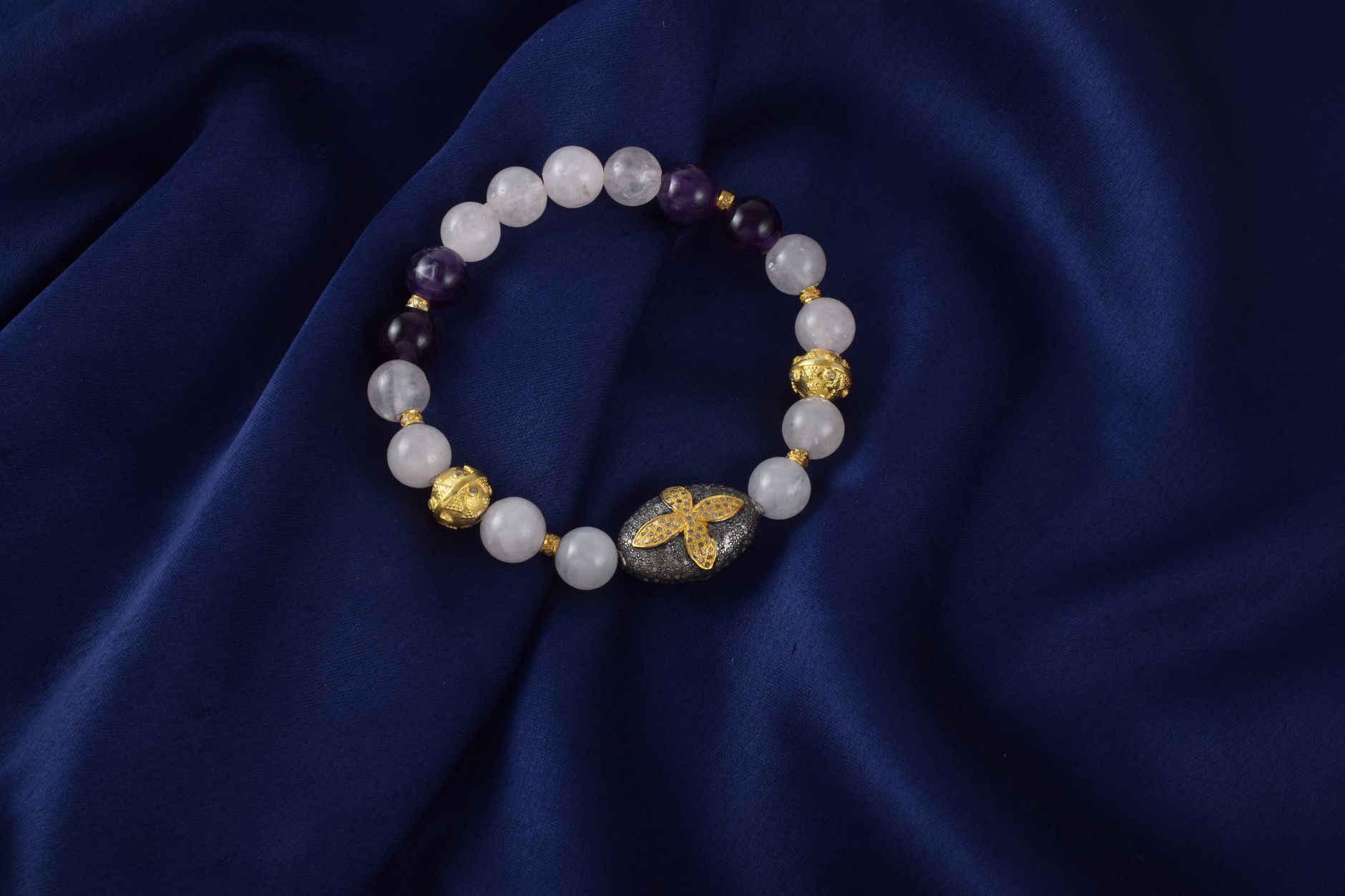
Amethyst is a variety of quartz recognisable by its violet colour, valued in jewellery for its accessibility and the wide range of shades it offers, from pale mauve to deep, almost dark purple. Associated with serenity and clarity of mind since antiquity, it remains one of the most widely used fine stones in necklaces, rings and earrings. This guide explains what amethyst really is, where its colour comes from, its history, its traditional virtues, and how to choose and care for a piece of jewellery set with it.
What is amethyst?
Amethyst belongs to the quartz family, one of the most common minerals in the Earth’s crust, which explains its relative affordability compared with rarer precious stones such as sapphire or ruby. It is classed among fine stones, a category that groups gems valued for their beauty without reaching the rarity of the four historic precious stones.
On the Mohs scale, which measures mineral hardness, amethyst rates 7, a level sufficient to withstand everyday use in jewellery while remaining softer than sapphire or diamond.
Where does amethyst’s violet colour come from
Amethyst’s characteristic colour comes from traces of iron within the quartz’s crystal structure, combined with natural irradiation that occurred during its geological formation. This combination produces a shade ranging from very pale mauve to intense purple, sometimes tinged with reddish or bluish reflections depending on the deposit.
The intensity of the colour remains the main value criterion for an amethyst: a deep, evenly coloured stone with no faded zones is generally more sought after than a pale or uneven one. Prolonged exposure to strong sunlight can fade this colour over time, a point worth keeping in mind when caring for a regularly worn piece of jewellery.
Where amethyst is found around the world
The main amethyst deposits are located in Brazil and Madagascar, two countries that supply most of current world production. Uruguay is also known for its spectacular geodes, while smaller deposits exist in France, Russia and Zambia.
Once a rare stone, now abundant
Until the discovery of the large Brazilian deposits in the 19th century, amethyst was considered a precious stone on a par with ruby or emerald, reserved for nobility and clergy. The identification of abundant reserves then caused its relative value to drop, moving it into the fine-stone category, now far more accessible in everyday jewellery.
The history and meaning of amethyst
The name amethyst comes from the ancient Greek amethystos, which literally means “not intoxicated”. In Greek mythology, the stone was believed to protect its wearer from the excesses of drinking, a belief that has endured through the centuries and continues to feed its symbolism of temperance and clarity of mind.
Amethyst has also adorned numerous royal and ecclesiastical jewels in Europe, notably bishops’ rings, where its violet colour evoked spirituality and religious dignity. It is today the birthstone traditionally associated with the month of February in Western calendars.
The virtues traditionally attributed to amethyst
In popular beliefs and crystal healing, amethyst is associated with serenity, clarity of mind and protection against excess and stress. It is sometimes presented as a stone that promotes restful sleep when placed near the bed.
These virtues stem from symbolic and traditional beliefs, passed down since antiquity, without established scientific basis. They are in no way a substitute for medical advice or the guidance of a health professional on any question relating to wellbeing or sleep.
Amethyst in jewellery: necklace, ring and earrings
Amethyst suits every type of jewellery, but it is especially prized as a pendant or necklace, where its violet colour stands out fully against a silver or gold setting. For a pendant worn close to the neck, the necklace length chosen directly affects how the stone is shown off: a choker accentuates the jewel’s effect, while a mid-length style lets the stone rest naturally on the chest.
The choice of setting also plays an important role in the final look. A sterling silver or gold-plated necklace gives two very different moods to the same stone: silver accentuates the cool reflections of the purple, while gold brings a warmer contrast. Amethyst is also found in rings, often surrounded by small diamonds or cubic zirconia, a setting close to the one used for sapphire, another fine stone prized for its intense colour.
How to choose and care for an amethyst piece of jewellery
Four main criteria guide the choice of an amethyst: the intensity and evenness of the violet colour, the stone’s clarity, its weight expressed in carats, and the quality of the setting. A deep purple stone with no visible inclusions remains the most valued, even though amethyst tolerates small imperfections better than rarer precious stones.
The price of an amethyst
The price of an amethyst stays moderate compared with other fine or precious stones, thanks to the abundance of current deposits. It mainly rises with the intensity of the colour and the size of the stone, far more than with its geographic origin, unlike stones such as sapphire where provenance weighs heavily on value.
Everyday care
Amethyst requires simple care: cleaning with lukewarm soapy water and a soft brush is enough in most cases. It is best to avoid harsh chemical products and prolonged sun exposure, which can fade its violet colour over time. As the birthstone for February, it also makes a natural gift idea for a birthday falling that month: the guide on what jewellery to give for a birthday details other useful criteria for choosing a gift based on budget and the recipient.
Frequently asked questions
What benefits are traditionally attributed to amethyst?
In popular beliefs and crystal healing, amethyst is associated with clarity of mind, serenity and protection against excess. These virtues stem from symbolic beliefs passed down since antiquity, without established scientific basis, and are not a substitute for any medical or professional advice.
Who can wear an amethyst piece of jewellery every day?
Amethyst, rated 7 on the Mohs scale, is a reasonably hard stone that suits everyday wear in a necklace or earrings, provided it is kept away from hard knocks and prolonged sun exposure, which can fade its colour over time.
How should an amethyst stone be cleaned and cared for?
Cleaning with lukewarm soapy water and a soft brush is enough in most cases. It is best to avoid repeated ultrasonic baths and harsh chemical products, which can weaken the stone or alter its violet shade over time.
What is the price of an amethyst?
The price of an amethyst stays moderate compared with other fine stones, since deposits are abundant. It mainly varies with the intensity of the violet colour, the size of the stone measured in carats, its clarity and the quality of its setting.
Why is amethyst associated with the month of February?
Amethyst is the birthstone traditionally linked to the month of February in Western calendars. This long-standing cultural association makes it a frequent gift choice for a birthday falling that month.